What Currency Can I Use in Morocco: A Practical Guide
Morocco runs on dirhams, and you can't buy them before you arrive. What cash to bring, where cards actually work, and how to avoid bad ATM rates.
Categories
Travel Tips
Posted By
Noureddine Ingrioui
Lead Tour Guide
Posted on
The Moroccan dirham (MAD) is the only legal currency for everyday spending in Morocco. Bring foreign cash or a working card, then convert on arrival, because the dirham is a closed currency.
You can't treat Morocco like a country where any major currency works at the counter. On the ground, the money answer is simple. Use Moroccan dirhams for normal spending, then rely on foreign cash or a card to get those dirhams once you land. That is the practical setup for first-time travelers who want fewer surprises and fewer bad conversions.
Table of Contents
- The Currency That Actually Works in Morocco
- Why the Dirham Is a Closed Currency
- Spend by category, not by hope
The Currency That Actually Works in Morocco
The only currency that works for daily spending in Morocco is the Moroccan dirham (MAD), also written as DH. Bank Al-Maghrib issues it under Law n°76-03, and it is a restricted currency, so it is not treated like a freely traded international cash currency. Customs guidance also makes the practical rule plain, visitors may bring in no more than 1,000 dirhams, while foreign banknotes valued at 100,000 dirhams or more must be declared at entry. That is the basic frame you need before you think about taxis, meals, or shopping. Moroccan customs guidance on the dirham and entry rules
Dirham notes come in the denominations you will handle most often, 20, 50, 100, and 200. Smaller coins matter for coffee, change, parking, and tiny day-to-day payments. If you are new to Morocco, carry a mix of small notes from the start. That saves time and avoids awkward change problems in medinas and taxis.
Foreign currency does not function as everyday money here. Euros, U.S. dollars, and pounds are not what you hand over for a taxi, a tagine, or a souvenir stall. You can sometimes get away with foreign cash in tourist settings, but that is not the same as using it properly. The right move is to arrive with a card or foreign cash, then convert into dirhams as soon as you need spending money.
Practical rule: if you are buying anything ordinary in Morocco, assume the seller wants dirhams, not your home currency.
For first-time visitors, the plan is straightforward. Bring a working bank card or a small amount of foreign cash. Convert on arrival. Keep enough small MAD notes for the first day or two, then top up from ATMs or exchange counters as needed. If you want a broader planning checklist before you lock your route, see our practical guide to choosing Morocco trip priorities.
Why the Dirham Is a Closed Currency
Morocco keeps the dirham in a closed-currency system. You generally cannot buy it outside the country, so do not plan on arriving with your wallet already full of local cash. The exchange system is tightly managed, and the dirham trades inside a 5% band around a reference rate weighted 60% to the euro and 40% to the U.S. dollar. That is formal exchange control, not free convertibility. Moroccan exchange controls and trading band
That status changes how you handle money. Bring foreign cash or a bank card, then get dirhams after arrival. Keep your leftover dirhams in mind too, because they are trip money, not something to stash for your next international break. Treat them as cash for this stay only.
If you carry foreign banknotes valued at 100,000 dirhams or more, declare them at customs. That is the threshold that matters. The rule is there to keep cash movement inside the country controlled and documented.
For a first trip, the practical answer is simple. Land with a card, some foreign cash, or both. Change money once you arrive, then top up through airport cash points, city ATMs, banks, or licensed exchange desks. Do not arrive assuming the wrong currency will work like local money. It will not.
Where Cards Work and Where They Don't
Cards work in Morocco, but only in the places where tourists usually spend bigger money. That means hotels, larger restaurants, airports, supermarkets, and some higher-end businesses. In those settings, card payments are normal enough. Outside them, cash is still the rule. Souks, small shops, taxis, and many rural services usually want dirhams, not plastic. Cash-first payment patterns in Morocco Why cash still dominates in markets and taxis
Spend by category, not by hope
If you organize your money by spending type, the pattern becomes easy.
Spending TypeCard AcceptedCash RecommendedNotesLodgingUsually yesCarry someHotels and many riads take cards, but cash helps with extrasFoodSometimesYesLarger restaurants may take cards, small cafes usually do notShoppingSometimesYesSouks and small stalls are cash territoryTransportRarelyYesTaxis are generally cash-basedTippingNoYesKeep small dirham notes for tipsRural servicesRarelyYesAssume cash unless told otherwise
That table is the cleanest way to think about it. If you are sleeping in a riad booked online, paying for a nice dinner, or stocking up at a supermarket, your card may work. If you are buying spices in a medina, paying a taxi, or leaving a tip, expect to use cash. Do not wait until the last second to figure that out.
Cash is the default outside major urban and tourist zones. Treat your card as support, not as the main plan.
For travelers who like to manage spending with a travel card, a useful technical explainer is the crypto card travel guide. The key point for Morocco is still the same. Use cards where they are reliable. Carry dirhams where they are not. That split keeps you from getting stuck in front of a taxi driver or a market stall.
Getting Cash From ATMs the Smart Way
ATM cash is the easiest way to get dirhams once you are in Morocco, but only if you use the machine correctly. Many foreign cards work in Morocco, and the machine should dispense Moroccan dirhams, not foreign currency. The big mistake is accepting the ATM's offer to charge you in your home currency. That is dynamic currency conversion, and it is the wrong choice. Always choose MAD. ATM guidance for foreign cards in Morocco
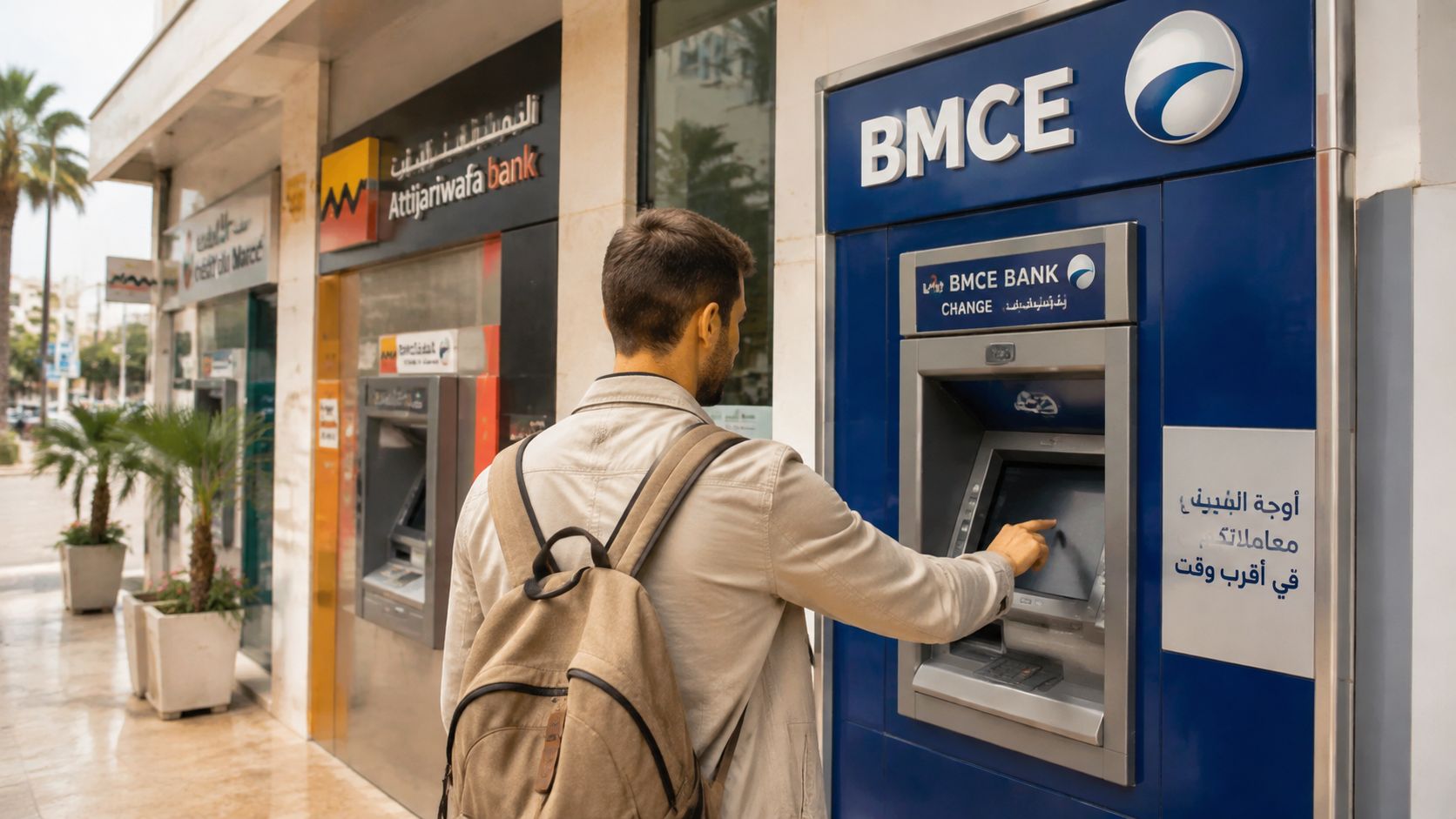
Use the machine, not the ATM's conversion offer
The cleanest approach is simple. Find a bank ATM. Use your Visa or Mastercard debit or credit card if it is supported. Decline conversion to your home currency. Take the dirhams. That keeps the bank or card network handling the exchange instead of the ATM operator. Sources also warn that the ATM's offered conversion is usually worse than your own card rate. ATM conversion advice for Morocco
Withdrawal limits matter too. They usually sit between 2,000 and 4,000 MAD per transaction, so it is smarter to take out larger amounts less often rather than making repeated small withdrawals. A later cash withdrawal usually beats paying a fee on every tiny stop. That matters because some reports note a flat 35-dirham fee on withdrawals, and that kind of charge gets painful fast if you keep drawing small amounts. ATM fee and contactless payment coverage in Morocco
Keep this simple: use a bank ATM, choose MAD, withdraw more once, and stop the machine from doing the conversion for you.
If you want a separate reference on which institutions refund ATM fees in some markets, the ATM fee refund list by Senki is useful context for fee-aware travelers. It is not Morocco-specific, but the principle is the same. Know what your card issuer charges before you start pulling cash.
Exchanging Foreign Cash Without Losing Money
If you arrive with euros, pounds, or U.S. dollars, you can exchange them in Morocco without drama. The main question is where. The best practical choice is usually a major bank branch in a city center. Official exchange counters are close behind. Hotel desks are convenient, but they tend to give you a worse deal. Airport exchange kiosks are the least attractive option for most travelers. Exchange options and airport warning
What to bring and what to expect
Bring clean, untorn bills in good condition. Damaged notes are often refused or treated badly. That is especially important if you are carrying older cash from home. When you look at a posted exchange board, compare the buy and sell lines, not just the headline number. The spread is where the margin sits. A “no commission” sign does not tell you much if the rate itself is weak.
Do not exchange everything at once. Change enough for your current spending, then top up later if you need to. That keeps you from getting stuck with too much local cash at the end of the trip. If you do end up with leftovers, use the airport or an exchange desk before departure to convert what you can. For trip planning questions that come up once money is sorted, our Morocco travel FAQ is the place to start.
OptionTypical RateConvenienceBest UseMajor bank branchStrongerModerateLarger exchanges in city centersOfficial exchange deskGoodHighQuick conversion in medinas and tourist areasHotel deskWeakerVery highSmall emergency exchanges onlyAirport kioskWeakestVery highMinimum cash on arrival only
That is the hierarchy we recommend. If you care about getting more dirhams for your money, skip the airport for anything beyond a small first exchange. Do the larger conversion in town, where you have better choices and less pressure.
Tipping, Taxis and Small Daily Cash Situations
The daily cash moments in Morocco are the ones that catch first-time travelers off guard. You are not pulling out a card for every small thing. You are handing over a small dirham note, often while moving quickly. That happens with taxis, baggage help, simple meals, parking, hammams, and tips for service staff. Keep small notes ready. That is the habit that makes the day run smoothly.
The small-payments rhythm
In a medina, a taxi driver may expect cash the moment you arrive. In a souk, a stallholder will not wait while you look for card payment options. In a hammam, the payment and the tip are usually handled in cash. If a porter carries luggage or a guide helps with a service stop, a small cash tip is the normal way to settle it. The exact amount depends on the setting, but the idea is the same. Round up and keep moving.
Petit taxis are especially important. They are usually cash-based, and it is smart to agree on the price before you sit down if the meter is not being used. That removes friction. It also avoids the uncomfortable moment when the ride ends and nobody likes the number being discussed. For solo travelers, especially women managing arrivals and night transfers, practical cash handling matters even more. Our solo female traveler guide for Morocco covers the broader safety side of that planning.
If you are picturing the classic scene, it is simple. You leave Jemaa el-Fnaa at night. You hand the driver a small note. You do not ask if a card machine is hidden in the glove box. You just pay in dirhams and leave.
Cash rule for the day: if the purchase is small, local, or awkward to negotiate, assume cash.
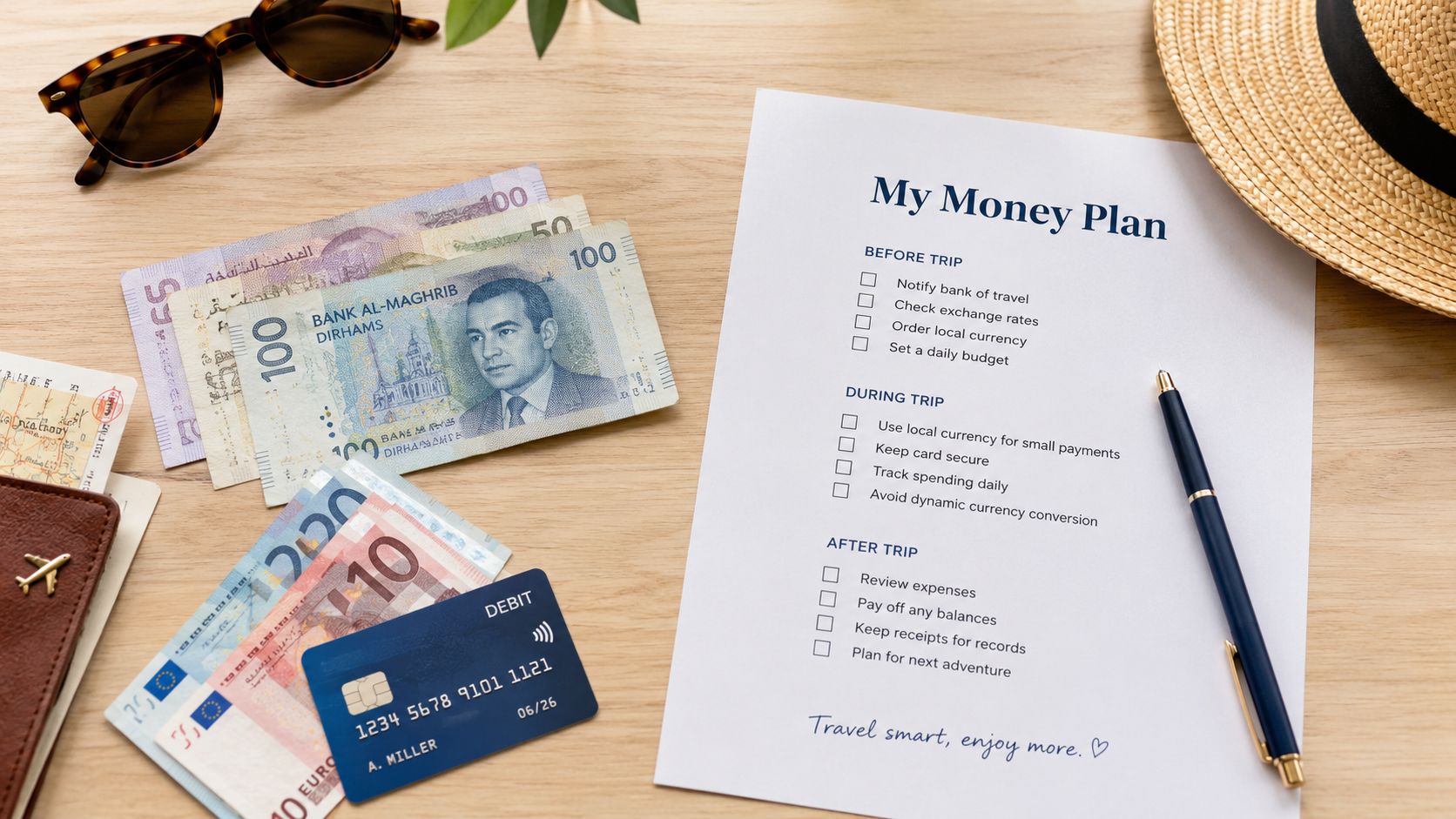
A Simple Money Plan for Your First Trip
Use a simple sequence and you will avoid most money mistakes in Morocco. First, arrive with a small amount of dirhams or euros, enough to cover the airport taxi and your first meal. Second, withdraw most of your spending money from a bank ATM in a city like Marrakech, Fes, or Casablanca, and always decline conversion to your home currency. Third, keep a backup card in a separate pocket. Fourth, hold some foreign cash in euros or U.S. dollars for places where your card still fails, especially in rural stretches and souk-heavy days.
A practical cash rhythm works better than a complicated one. You do not need to carry your whole budget in your wallet. Keep enough for the day, then top up when you are back near a good ATM or exchange desk. That lowers stress and makes loss less painful. It also helps if one card gets blocked, because you still have a second one and some backup cash.
For a first trip, think in spending categories instead of one giant pile of money. Meals, local transport, entry fees, and small tips are the cash-heavy parts. Lodging and bigger restaurant bills are where a card may help. If you are moving between Marrakech, the Atlas, the desert, and the coast, that split becomes even more useful because payment options change with the setting.
Here is the rule we give travelers. Bring enough easy cash for the first day. Use ATMs for the rest. Never let the ATM choose your currency for you. Keep your receipts if you exchange or withdraw a lot, especially if you need to reconvert leftover cash before you leave. Customs rules still apply at entry, including the 100,000-dirham declaration threshold for foreign banknotes and the guidance on limited cash import for travelers. Moroccan customs guidance on cash rules
Moroccan Guides Travel builds private Morocco itineraries around the way you move, pay, and spend on the ground. We can plan around cash-heavy medinas, card-friendly hotels, desert transfers, and the practical stops between them. Visit Moroccan Guides Travel and request a free custom itinerary built around your dates, route, and comfort level.
Thanks for reading
For over 20 years, we've been guiding travelers across Morocco from the peaks of the Atlas Mountains to the depths of the Sahara. To explore Morocco your own way and support our work, check out our private tours and Tailor Made Morocco Tours.
“I read every request myself, and reply the same day where I can.”
Noureddine Ingrioui
Founder & Tour Guide
Plan Your Private Morocco Tour
Ready to take the next step? Whether you’re ready to book or just exploring possibilities, we’re here to help. Share a few details with us, and our team will reach out
Plan Your Private Morocco Tour
Ready to take the next step? Whether you’re ready to book or just exploring possibilities, we’re here to help. Share a few details with us, and our team will reach out
“I read every request myself, and reply the same day where I can.”
Noureddine Ingrioui
Founder & Tour Guide
.webp)