Best Time to Visit Morocco by Month and Region
Categories
Travel Tips
Posted By
Noureddine Ingrioui
Lead Tour Guide
Posted on
Most guides get Morocco wrong by turning the whole country into a spring-or-fall answer. That's too simple for real trip planning. The best time to visit Morocco depends on route design, not on one magic month, because Marrakech, the Atlas, the Sahara, and the Atlantic coast don't follow the same calendar. If you want a clean, low-risk first trip, we have to match the month to the regions you're crossing.
We build private itineraries in Marrakech every day, and we plan them around comfort, road conditions, and how much moving around you want to do. A couple heading to Fes and the desert needs different dates than a family aiming for Essaouira and the coast, and both need different dates than a traveler who wants mountain walking plus sand dunes in one route. That's the planning problem.
Table of Contents
Why the Best Time to Visit Morocco Is Not One Month
“Spring or fall” is lazy advice. Morocco needs region-by-region timing, because Marrakech, Agadir, Casablanca, the Atlas, and the Southern Provinces do not share the same travel rhythm. A single calendar works for some routes and fails for others. That is why the seasonality profile varies so much across the country, with the coast and major cities staying more forgiving while the mountains and southern areas swing harder between busy and quiet periods seasonality study.
Match the month to the route
A city-focused trip has more flexibility than a route that mixes desert and mountains. A traveler staying mostly on the Atlantic coast can handle summer better than someone crossing the High Atlas and sleeping in the Sahara. The same goes for families, who usually do better with shorter transfers and cooler coastal bases, and for travelers who want comfort over packing too much into one route.
A good date for one itinerary can be a poor date for another.
The shoulder season still gives the best balance for most mixed routes. Independent planning guides consistently point to March to May and September to October as the most comfortable windows, with April and October standing out as especially strong choices Intrepid Travel, Audley Travel, Enchanting Travels. I agree, but only for the right kind of trip. Those months fit mixed itineraries well. They are not always the smartest pick for beach-first summer travelers, diaspora trips shaped by family schedules, or visitors who want a quieter desert experience.
The part most guides miss
The question that matters is when the coast, cities, and flights line up for your specific trip. Generic advice leaves out summer travel, especially for families and repeat visitors, and it also misses the fact that winter can be a strong choice when your plan centers on sunny desert days and lower crowds Morocco World News coverage of 2025 tourism demand. The right timing is route design, not a slogan.
Morocco's Climate Regions and Why They Decide Your Dates
Morocco behaves like several countries stitched together. That's not a cliché, it's the operational truth. If you only think about temperature, you'll miss the bigger issue, which is whether your roads, hikes, and day trips still make sense where you're going.
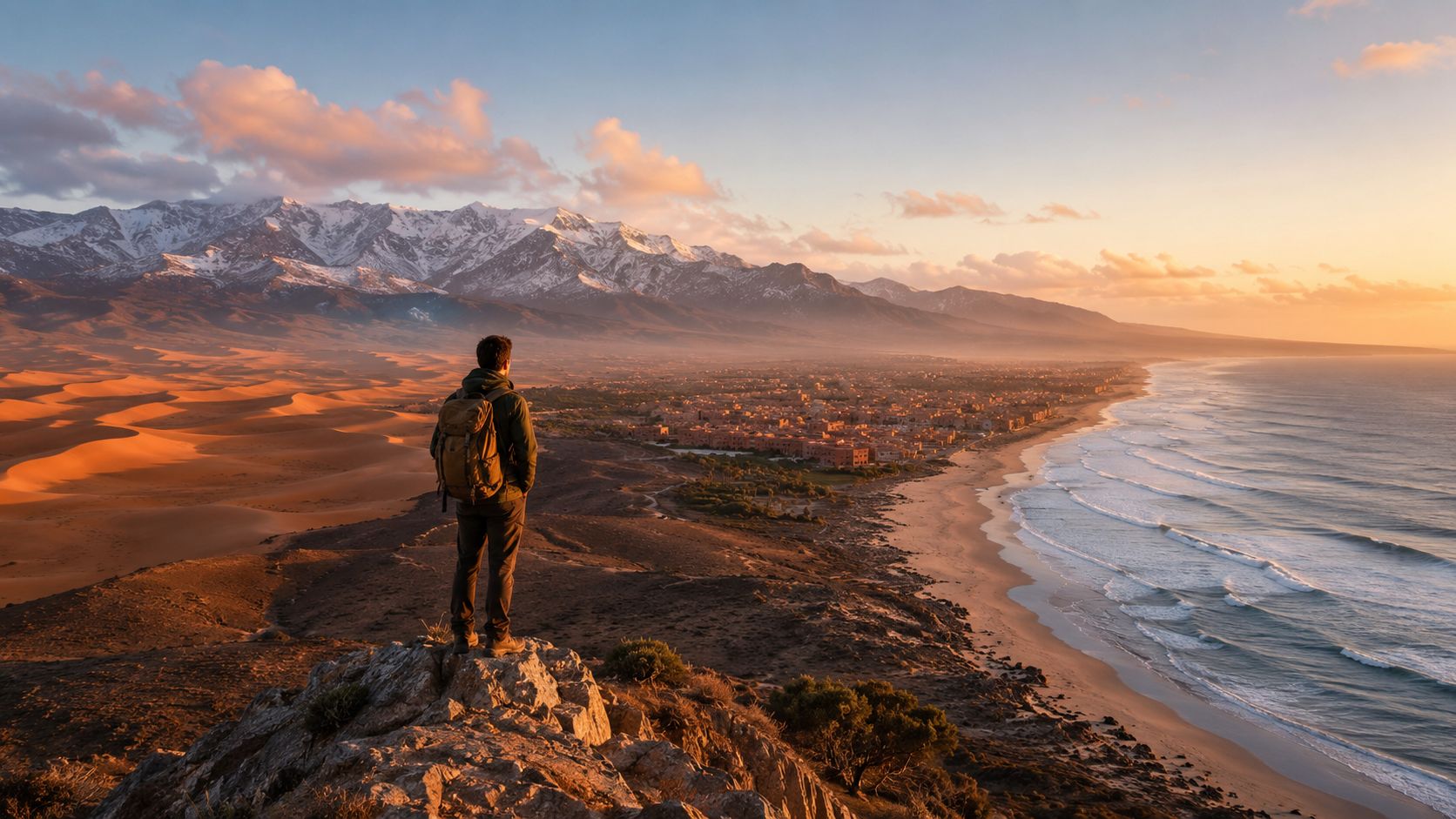
The coast, the inland cities, the mountains, the desert, and the north
The Atlantic coast includes Essaouira, Agadir, and Casablanca. It stays the most forgiving in summer, which is why the coast often becomes the right answer when inland heat climbs. Winter there is milder than in the interior, so coastal itineraries have a longer usable season than most first-time travelers expect.
The imperial cities like Marrakech and Fes are a different story. They heat up fast in summer and cool down at night in winter, so daytime comfort changes a lot by month.
The High and Middle Atlas are driven by elevation. Snow changes route access from winter into early spring, so trekking and cross-mountain driving need more caution than city travel.
The pre-Saharan and Saharan fringe around Merzouga, Zagora, and M'hamid runs on desert logic. Summer heat is the main problem, while winter nights can be very cold. The Sahara remains viable for much of the year, but comfort and timing are different from the cities.
The Mediterranean north around Tangier and Chefchaouen behaves more like southern Spain than Marrakech. It has its own rhythm, and it does not follow the same rules as the interior.
Morocco's Five Climate Regions at a GlanceKey CitiesSummer CharacterWinter CharacterBest SeasonAtlantic coastEssaouira, Agadir, CasablancaCooler and more usable than inlandMild, with less severe cold than mountainsSpring, summer for beach-focused trips, early fallImperial citiesMarrakech, Fes, MeknesHot inland daysCool nights, workable daysSpring and fallHigh and Middle AtlasImlil, Ourika, Aït BouguemezGood for hiking at altitudeSnow affects access and trekkingLate spring and early fallSaharan fringeMerzouga, Erg Chebbi, OuarzazateHarsh midday heatClear skies, cold nights, manageable daysFall through early springMediterranean northChefchaouen, TangierMore moderate than MarrakechCooler and wetter than the southSpring, early summer, early fall
The planning mistake is to book a month before you know which regions are on the route. We do the opposite. We build the route first, then match the dates to the regions that matter most.
Month by Month Across the Country
January through March rewards travelers who build a route around lower traffic and keep the mountain section flexible. January works well for a Marrakech, Ouarzazate, Merzouga loop, because the road over the Tizi n'Tichka is often usable outside snow events, while a serious Toubkal trek should wait for a better climbing window. February stays similar, with calm city days and sharp desert nights, so plan for short walking days and warm layers after sunset. March is the month when the country starts to open up again, especially if you want to combine cities with the Sahara and avoid the roughest winter access in the Atlas.
April through June is the strongest stretch for most first-time routes. April gives you comfortable city walking, workable transfers, and decent hiking conditions in the lower Atlas. May usually stays excellent for the classic Marrakech to desert run, with heat still manageable and day trips from the cities still pleasant. June is the smart pick if you want the same broad routing with fewer school-holiday crowds, but I would still keep the mountains modest and avoid packing too much altitude into one week. If you are choosing between a coast-heavy trip and a city-plus-desert trip, June can handle both, but the coast will feel easier.
July through October is where generic advice falls apart. July and August are poor choices for inland sightseeing if you care about comfort, but they are exactly when the Atlantic coast earns its keep, so build around Essaouira or Agadir and keep Marrakech, Fes, and the deep desert as short add-ons. This is also when demand runs hot, so the smart move is to book the route that best fits the season instead of forcing an inland-heavy trip. September is the clean rebound. The heat backs off, the roads settle, and mixed itineraries become easy again. October stays strong for the same reason, and it is one of the easiest months to balance city time, desert nights, and longer drives without compromise.
November is underrated because it gives you good city weather and solid desert conditions without the pressure of peak-season routing. It works well for Marrakech, Fes, and a Saharan loop, but once you start pushing into the higher Atlas, you need to watch the weather closely. December still works for a relaxed winter trip if you keep expectations grounded. Cities stay pleasant in the day, the desert is still viable, and the coast remains mild, but mountain crossings can become the weak link, so do not build your whole plan around them. For route ideas that map cleanly by month, this Morocco month-by-month route planner is useful.
MonthOverall RatingImperial CitiesAtlas TrekkingSahara DesertAtlantic CoastJanuaryMixedGood for short city staysRisky in snow periodsGood for clear skiesMildFebruaryMixedGoodRiskyGoodLess strong for surf planningMarchStrongVery goodImprovingVery goodGoodAprilExcellentExcellentExcellentExcellentVery goodMayExcellentExcellentExcellentExcellentVery goodJuneStrongGood to very goodGoodGood to fairExcellentJulySelectiveHard inlandLimited except at altitudePoor by midday heatExcellentAugustSelectiveHard inlandCrowdedPoor by midday heatExcellentSeptemberExcellentExcellentExcellentExcellentVery goodOctoberExcellentExcellentExcellentExcellentVery goodNovemberGoodGoodFair to goodGoodGoodDecemberMixedGoodRiskyGoodGood
Best Time to Visit by Traveler Type
Dates make sense faster when we stop thinking like a calendar and start thinking like a traveler. A couple, a family, and a retiree all need different trade-offs. So do summer visitors who are tied to school holidays or family events.
Book the window that fits your real constraints
Couples should aim for April, May, September, or October. That gives you the best balance of light, comfort, and easy routing. If you want fewer people in the headline sites, go early in the shoulder season rather than late.
Families tied to school breaks should stop fighting summer. If the trip is coast-first, July and August can work well, especially when Essaouira or Agadir anchor the itinerary. The coast handles summer better than the interior, and that is the part of the advice many overlook.
Solo travelers who care about value and flexible pacing can use late spring or late fall, then move slightly outside the obvious peak weeks. That usually gives better room choice and calmer routing without forcing a compromise on weather.
Photographers should lean toward shoulder-season dates and avoid the most obvious crowd spikes around major holidays. Empty medinas are easier to find in quieter months than in school-holiday periods.
Retirees who can choose freely should book late April or October. Those months reduce the chance of uncomfortable heat and keep city walking and transfer days manageable.
Diaspora travelers coming home in summer should not feel pressured to avoid July and August. If family weddings, reunions, and beach time are the point, the calendar should serve that plan instead of blocking it.
The right month is the one that serves your actual priorities, not the month that looks best on a generic guide.
Traveler TypePrimary WindowBackup WindowKey Trade-offCouplesApril, May, September, OctoberLate March or early NovemberBest balance of comfort and routingFamiliesJuly, August for coast-focused tripsJune or SeptemberSchool calendars versus inland heatSolo travelersLate spring or late fallShoulder-season edge datesValue versus peak crowd densityPhotographersShoulder seasonQuieter winter city staysCrowd control versus light qualityRetireesLate April or OctoberEarly May or late SeptemberComfort versus trip flexibilityDiaspora travelersJuly and AugustDecember holiday periodsFamily timing versus summer heat inland
We also see a strong case for a July to August Atlantic coast trip when the traveler's goal is beach time, surf, and family logistics rather than mountain trekking. That is the contrarian answer, and it's often the right one.
Best Time to Visit by Activity
Activities have their own calendar, and that's where many trips go wrong. A month that works for Marrakech rooftops can be a bad month for the High Atlas. A month that feels easy for the coast can be brutal in the Sahara.
Trekking, desert, coast, and cities each want different dates
Atlas trekking belongs in late April to early June and again from mid-September to late October. Those windows give you the most dependable conditions for the High Atlas valleys and Toubkal-area planning. July and August can work only at higher elevation, while December through February is a poor bet if your route depends on mountain passes.
Sahara and Erg Chebbi work best from October through April. That keeps you away from the harshest midday heat. Standard 4x4 desert trips still function in summer, but comfort drops fast and the whole experience becomes harder to pace.
Atlantic coast and surf are strongest from October through April, with June and September as good shoulder months when the water and wind patterns line up better for many beach-focused travelers. Essaouira and Taghazout suit that pattern well.
Imperial cities such as Marrakech, Fes, Meknes, and Rabat are easiest from October through April. Summer evenings can still work for rooftop dining and late walks, but daytime city touring becomes much less forgiving.
Operational note: if your route includes desert plus mountains, don't let a pretty calendar override road reality.
There are also a few bad fits worth stating plainly. Christmas and New Year in the Sahara are operationally tight. August in the Atlas can be crowded. February is weak for Atlantic surf if your whole trip depends on that activity. That doesn't make those months unusable. It just means the activity has to match the date, not the other way around.
If your main aim is a Sahara-first itinerary, our Sahara desert Morocco planning guide will help you think through route structure before you lock dates.
ActivityPeak MonthsShoulder MonthsAvoid MonthsAtlas trekkingLate April, May, early June, mid-September to late OctoberMarch, NovemberDecember to February for pass-dependent routesSahara desertOctober to AprilLate September, early MayJuly and August midday travelAtlantic coast and surfOctober to AprilJune, SeptemberFebruary for surf-dependent tripsImperial citiesOctober to AprilMay, early June, SeptemberPeak summer afternoons
Timing Variables Beyond the Weather
Weather is only half the story. The other half is calendar pressure, religious rhythm, and access. If you ignore that layer, you can choose a good month and still get a messy trip.
Ramadan, festivals, and school holidays change the feel of the country
Ramadan moves about 11 days earlier each year, so the same month can feel different depending on the year Morocco Escape on timing around Ramadan. During Ramadan, daytime operations can be compressed, while evenings become fuller and more social. That matters for clients who want restaurant flexibility, museum timing, or a packed sightseeing day.
Major festivals can also reshape availability. That includes Mawazine in Rabat, Fes Sacred Music, Gnaoua in Essaouira, the Imilchil Marriage Festival, the Date Festival in Erfoud, and the rose harvest in Kelaa M'Gouna. If you want to attend one intentionally, plan ahead. If you don't, avoid letting it happen by accident, because rooms and transport can tighten around those dates.
School calendars matter just as much. European and North American breaks push demand into July through mid-August, plus Christmas-New Year and Easter. French holidays also create a February spike and an All Saints' Day spike. On top of that, Eid al-Adha is the highest domestic travel week of the year, with severe price spikes and limited transport availability.
Don't choose weather in a vacuum. Choose the full calendar.
The Atlas adds one more planning layer. Some high passes close from November through March, so a route that looks fine on paper can fail on the road if you're trying to combine mountain and desert in one trip. That is why we always look at route access before we confirm dates.
How to Choose Your Travel Window
The clean way to choose Morocco dates is to work in four steps. First, define the route shape. Cities-only, coast, Atlas, desert, or a combination. Second, match that route to the traveler type. Third, overlay the festival and Ramadan calendar. Fourth, stress-test the plan against school-holiday pressure and seasonal road risk.

Two practical examples
A 10-day Marrakech, Fes, desert route works in both March and October, but for different reasons. March gives you a cooler transition into the desert and easier city walking. October gives you more consistent comfort across the whole route and a stronger overall margin if you want the Sahara, the imperial cities, and the transfer days to all feel smooth.
A family summer trip is different. If school breaks force July travel, the route should shift toward the coast and shorter inland hops rather than trying to force a mountain-plus-desert loop into hot conditions. That is where route design matters more than the month itself.
If you are also comparing air tickets, a useful planning piece on the best time for business class fares can help you line up flights before you lock hotels and drivers.
Use this checklist before you book
Confirm climate fit for every region on the route.
Check for festival conflicts unless you want to attend one on purpose.
Verify school-holiday pressure if your dates are fixed.
Leave buffer days if the route depends on Atlas crossings or desert transfers.
For a deeper route-planning lens, our what to know before choosing Morocco guide covers the practical details clients usually miss before they commit.
If you want us to turn this into a private plan, we'll build it around your route, not a generic month. Visit Moroccan Guides Travel and request a free custom itinerary, and we'll map the right dates to the coast, cities, Atlas, and Sahara for your trip.
Thanks for reading
For over 20 years, we've been guiding travelers across Morocco from the peaks of the Atlas Mountains to the depths of the Sahara. To explore Morocco your own way and support our work, check out our private tours and Tailor Made Morocco Tours.

“I read every request myself, and reply the same day where I can.”
Noureddine Ingrioui
Founder & Tour Guide
Plan Your Private Morocco Tour
Ready to take the next step? Whether you’re ready to book or just exploring possibilities, we’re here to help. Share a few details with us, and our team will reach out
Plan Your Private Morocco Tour
Ready to take the next step? Whether you’re ready to book or just exploring possibilities, we’re here to help. Share a few details with us, and our team will reach out
“I read every request myself, and reply the same day where I can.”
Noureddine Ingrioui
Founder & Tour Guide